Responsible AI: Building
Ethical AI Systems for Your
Business
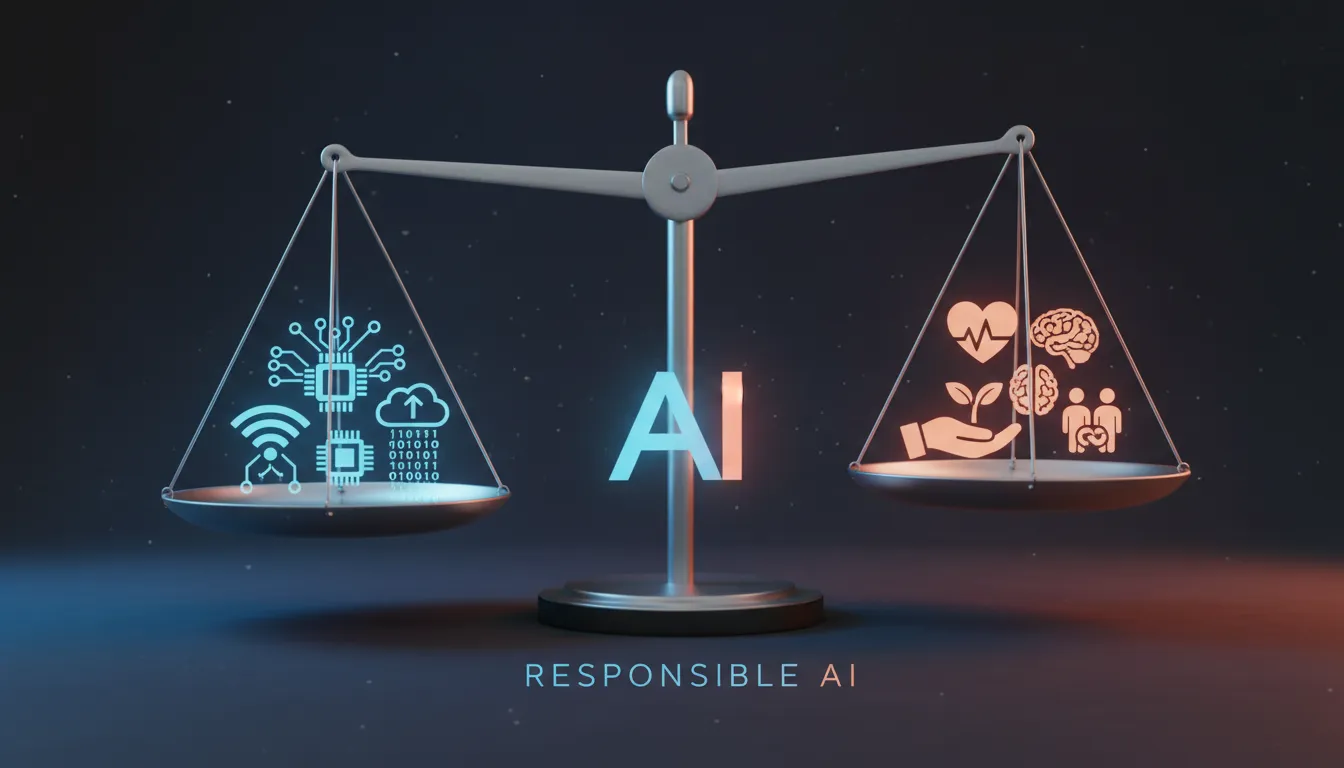
As AI becomes embedded in more business decisions—who gets a loan, which candidates advance in hiring, what content users see—the stakes of getting it wrong have never been higher. Responsible AI isn't an abstract philosophical exercise. It's a practical discipline that protects your customers, your reputation, and your bottom line.
Why Ethical AI Is a Business Priority
Some leaders still view AI ethics as a nice-to-have or a compliance checkbox. That perspective is increasingly dangerous. Here's why responsible AI deserves executive attention.
The Business Case
- Regulatory risk: AI regulations are expanding globally. Non-compliance can mean fines, lawsuits, and operational disruptions.
- Reputational risk: A single biased algorithm can generate headlines that take years to recover from.
- Customer trust: Consumers and B2B buyers increasingly care about how companies use AI. Transparency builds loyalty.
- Better outcomes: Ethical AI practices—bias testing, diverse training data, human oversight—actually produce more accurate and reliable systems.
- Talent attraction: Top AI engineers and data scientists want to work for organizations that take responsible AI seriously.
Building ethical AI isn't about slowing down innovation. It's about building AI that actually works for everyone—and that means it works better for your business too.
Core Principles of Responsible AI
While frameworks vary, most responsible AI programs are built on five foundational principles.
1. Fairness
AI systems should treat all people equitably and not discriminate based on protected characteristics like race, gender, age, or disability.
What fairness looks like in practice:
- Testing models across demographic groups to identify performance disparities
- Using balanced and representative training data
- Defining fairness metrics appropriate to your specific use case (equal opportunity, demographic parity, individual fairness)
- Regularly auditing deployed models for emerging bias
A practical example: A financial services company using AI for credit scoring should verify that approval rates are equitable across racial and gender groups when controlling for legitimate risk factors. If disparities exist, the model needs adjustment—not just documentation.
2. Transparency
People affected by AI decisions should be able to understand how those decisions are made.
What transparency looks like in practice:
- Providing clear, plain-language explanations of how AI is used in your products and services
- Making model logic interpretable where possible, or using explainability tools where it isn't
- Disclosing when customers are interacting with AI rather than humans
- Publishing your AI principles and practices externally
3. Accountability
There must be clear human responsibility for AI outcomes. An algorithm can't be held accountable—but the people and organizations behind it can.
What accountability looks like in practice:
- Designating specific individuals or teams as responsible for each AI system
- Establishing escalation paths when AI systems produce unexpected or harmful results
- Maintaining audit trails that document how models were built, trained, and validated
- Creating feedback mechanisms so affected parties can challenge AI-driven decisions
4. Privacy and Security
AI systems often process vast amounts of personal and sensitive data. Protecting that data isn't optional.
What privacy looks like in practice:
- Collecting only the data you actually need (data minimization)
- Anonymizing or pseudonymizing personal data used for model training
- Implementing strong access controls and encryption for AI training data and models
- Conducting privacy impact assessments before deploying AI systems that process personal data
- Enabling data subject rights: access, correction, deletion, and portability
5. Safety and Reliability
AI systems should work as intended and fail gracefully when they encounter situations outside their training.
What safety looks like in practice:
- Extensive testing across edge cases and adversarial scenarios
- Human-in-the-loop designs for high-stakes decisions
- Monitoring deployed models for performance degradation (model drift)
- Kill switches and fallback procedures when AI systems malfunction
Identifying and Preventing Bias
Bias in AI is one of the most widely discussed—and most misunderstood—challenges in responsible AI. Here's a practical guide to addressing it.
Where Bias Comes From
Bias can enter your AI system at every stage:
- Historical data: If your training data reflects past discrimination, your model will learn and perpetuate it
- Data collection: Sampling methods that over- or under-represent certain groups introduce bias
- Feature selection: Using proxies for protected characteristics (zip code as a proxy for race, for example) embeds bias indirectly
- Labeling: Human annotators bring their own biases when creating labeled training data
- Optimization targets: Optimizing for engagement or conversion without fairness constraints can amplify existing inequities
A Practical Bias Prevention Framework
Before model development:
- Audit training data for representation gaps and historical biases
- Define fairness criteria with input from diverse stakeholders
- Document assumptions about what "fair" means for your specific use case
During model development:
- Test model performance across all relevant demographic segments
- Use bias mitigation techniques (re-sampling, re-weighting, adversarial debiasing)
- Compare multiple model architectures for fairness characteristics
After deployment:
- Monitor outcomes across demographic groups on an ongoing basis
- Establish thresholds that trigger review when disparities emerge
- Create accessible channels for users to report concerns about biased outputs
Navigating the Regulatory Landscape
AI regulation is accelerating worldwide. Understanding the key frameworks helps you build compliance into your AI systems from the start rather than retrofitting it later.
Key Regulations to Know
- EU AI Act: Classifies AI systems by risk level (unacceptable, high, limited, minimal) with corresponding requirements for transparency, human oversight, and documentation
- GDPR: Gives individuals the right to explanation for automated decisions and restricts automated decision-making in certain contexts
- US State Laws: Colorado, Illinois, and other states have enacted or proposed AI-specific legislation covering hiring, insurance, and consumer protection
- Industry-Specific Rules: Financial regulators (OCC, CFPB), healthcare regulators (FDA), and employment agencies (EEOC) are all issuing AI-specific guidance
Building a Compliance-Ready AI Program
Rather than reacting to each new regulation individually, build a foundation that adapts:
- Maintain an AI system inventory that catalogs every AI application, its purpose, data inputs, and risk level
- Conduct impact assessments before deploying AI in contexts that affect people's rights, access, or opportunities
- Document model development processes including data sources, training methodology, testing results, and known limitations
- Implement ongoing monitoring with regular audits and performance reviews
- Establish incident response procedures for when AI systems produce harmful or unexpected outcomes
Building an Ethical AI Culture
Policies and tools are necessary but not sufficient. Responsible AI requires a culture where ethical considerations are part of every conversation about AI.
Practical Steps to Build the Culture
- Start at the top: Leadership must visibly champion responsible AI, not just approve a policy document
- Train everyone: AI ethics training shouldn't be limited to technical teams. Product managers, business leaders, and frontline staff all play a role
- Create psychological safety: Teams need to feel safe raising concerns about AI systems without fear of being seen as obstacles to innovation
- Incentivize responsibility: If people are only measured on speed and accuracy, ethics will be an afterthought. Include fairness and transparency in performance metrics
- Learn from incidents: When things go wrong—and they will—treat it as a learning opportunity, not a blame exercise
The Ethics Review Process
For AI applications with significant potential impact, implement a structured review:
| Stage | Review Focus | Key Questions | |-------|-------------|---------------| | Concept | Purpose and impact | Who benefits? Who could be harmed? | | Data | Training data integrity | Is data representative? Are there known biases? | | Development | Model fairness | Does performance vary across groups? | | Deployment | Real-world behavior | Are outcomes aligning with expectations? | | Ongoing | Drift and emerging issues | Has anything changed since launch? |
Getting Started: Your Responsible AI Checklist
You don't need to build a perfect program overnight. Start with these foundational steps:
- Publish your AI principles: Even a simple statement of values creates accountability
- Inventory your AI applications: You can't govern what you don't know about
- Assess your highest-risk systems: Focus bias testing and oversight on AI that affects people's lives and livelihoods
- Designate an AI ethics lead: Someone needs to own this, even if it's a part-time role initially
- Start bias testing: Run fairness evaluations on your most impactful models
- Build feedback loops: Give customers and employees a way to flag AI concerns
The organizations that lead on responsible AI won't just avoid harm—they'll build deeper trust, attract better talent, and create AI systems that genuinely work for everyone they serve.
Want personalized guidance? Schedule a free consultation with our team.
Keep reading
Related Articles
Continue reading more insights from the CoreLinq team.