Measuring AI ROI: How to Track
the Impact of Your AI
Investments
One of the most common questions we hear from business leaders is simple but critical: "How do we know if our AI investment is actually working?" It is a fair question. AI initiatives can range from modest pilot projects to enterprise-wide transformations, and without clear measurement frameworks, it is impossible to know whether you are generating real value or just spending money on technology for its own sake.
This guide breaks down practical approaches to measuring AI ROI that work for organizations of every size.
Why Traditional ROI Calculations Fall Short
Standard ROI formulas work well for straightforward capital investments, but AI projects introduce complexity that traditional models struggle to capture:
- Compounding returns: AI systems often improve over time as they process more data, meaning early measurements understate long-term value.
- Indirect benefits: Improved employee satisfaction, faster decision-making, and better customer experiences are real but hard to quantify.
- Shifting baselines: The business environment changes around you, making before-and-after comparisons tricky.
- Upfront investment curves: AI projects typically require significant initial investment before delivering returns.
The goal is not perfect measurement. The goal is measurement that is good enough to make informed decisions about where to invest next.
A Practical Framework for AI ROI
We recommend a three-tier measurement approach that captures both hard financial returns and softer strategic benefits.
Tier 1: Direct Financial Impact
These are the numbers your CFO will care about most. Track them rigorously from day one:
- Cost reduction: How much are you saving in labor, materials, or operational expenses? Compare monthly costs before and after AI implementation for the specific process.
- Revenue increase: Is AI helping you close more deals, upsell existing customers, or enter new markets? Measure incremental revenue directly attributable to AI-driven initiatives.
- Error reduction: What is the financial cost of mistakes that AI is now preventing? Calculate the average cost per error multiplied by the reduction in error rate.
- Speed to value: How much faster are processes completing? Time savings translate directly to throughput and capacity gains.
For each metric, establish a clear baseline measurement before your AI implementation goes live. Without a baseline, you are guessing.
Tier 2: Operational Efficiency Metrics
These metrics capture improvements that feed into financial outcomes but deserve tracking on their own:
- Process cycle time: Measure the end-to-end time for key workflows before and after AI. A customer onboarding process that drops from 5 days to 2 days is a concrete, measurable win.
- Throughput volume: Track how many units of work (applications processed, tickets resolved, invoices handled) your team can manage with AI assistance versus without.
- Employee productivity: Measure output per employee hour in AI-augmented processes. Be careful to track quality alongside quantity.
- Data accuracy rates: If AI is handling data entry, classification, or analysis, track accuracy rates over time.
Tier 3: Strategic Value Indicators
These metrics are harder to quantify but often represent the most significant long-term value:
- Customer satisfaction scores (NPS, CSAT) for AI-touched interactions
- Employee engagement in teams using AI tools
- Time to market for new products or services
- Competitive positioning based on capabilities AI enables
- Decision quality measured through outcome tracking
Setting Up Your Measurement System
Knowing what to measure is only half the battle. Here is how to build a measurement system that actually works.
Step 1: Define Success Before You Start
Before launching any AI initiative, document specific, measurable success criteria. Use the SMART framework:
- Specific: "Reduce invoice processing time" not "improve efficiency"
- Measurable: "By 40%" not "significantly"
- Achievable: Based on realistic benchmarks, not wishful thinking
- Relevant: Tied to a business outcome that matters
- Time-bound: "Within 6 months of deployment"
Step 2: Establish Clean Baselines
Spend two to four weeks measuring current performance before deploying AI. Track the exact same metrics you plan to measure after implementation. Document the measurement methodology so you can replicate it consistently.
Step 3: Build a Dashboard
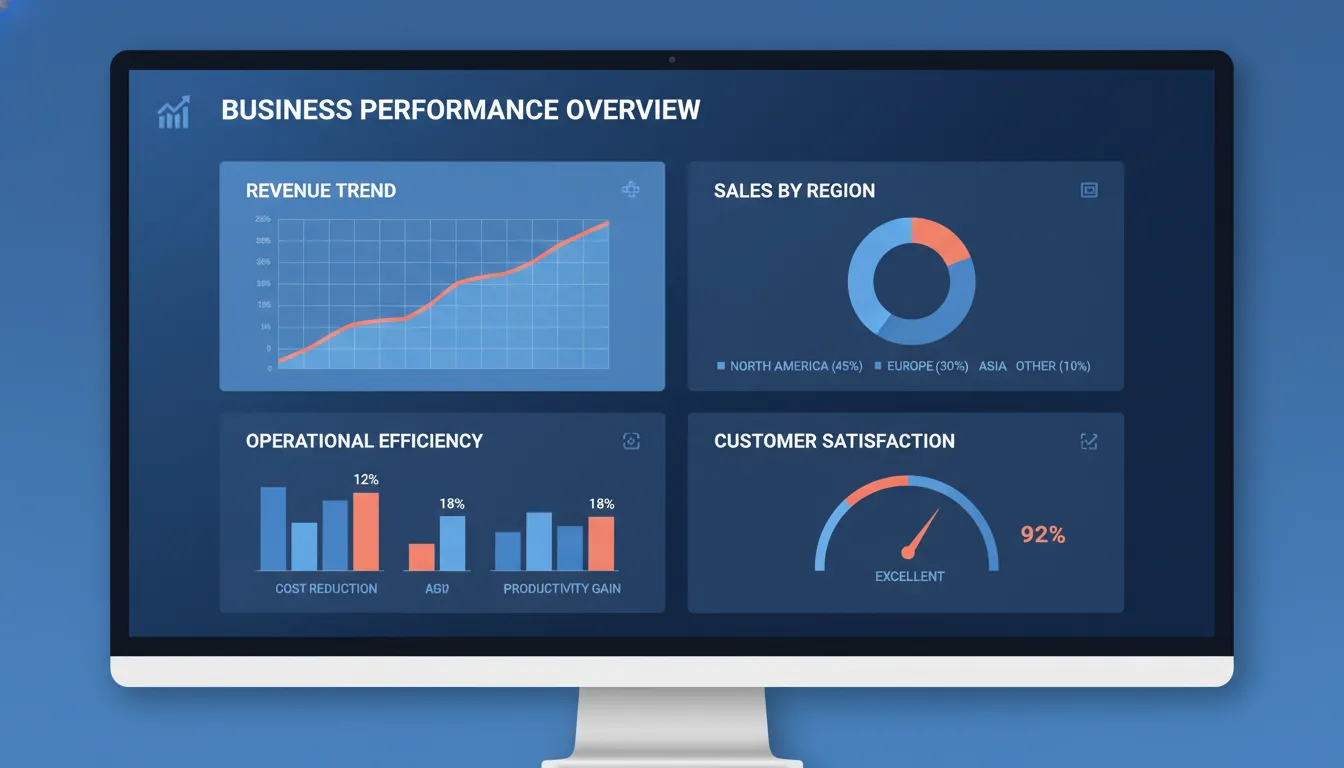
Create a simple dashboard that tracks your key metrics in real time. It does not need to be fancy. A well-structured spreadsheet updated weekly is better than an elaborate BI tool that nobody maintains. Include:
- Current performance vs. baseline
- Trend lines showing improvement (or decline) over time
- Total investment to date (including hidden costs like training and maintenance)
- Running ROI calculation
Step 4: Review and Adjust Quarterly
Schedule quarterly ROI reviews with stakeholders. Use these sessions to:
- Celebrate wins and share specific numbers
- Identify underperforming initiatives early
- Reallocate resources toward highest-ROI projects
- Update projections based on actual performance data
Common Metrics by Use Case
Different AI applications call for different primary metrics. Here are the most relevant KPIs for common use cases:
Customer Service AI
- Average handle time reduction
- First-contact resolution rate improvement
- Customer satisfaction score changes
- Cost per interaction
Sales and Marketing AI
- Lead conversion rate improvement
- Customer acquisition cost reduction
- Campaign performance lift
- Sales cycle length reduction
Operations and Process AI
- Processing time reduction
- Error rate reduction
- Throughput increase
- Compliance rate improvement
Data and Analytics AI
- Time to insight reduction
- Forecast accuracy improvement
- Report generation time savings
- Data quality score improvement
Accounting for Total Cost of Ownership
Honest ROI measurement requires honest cost accounting. Make sure you are capturing the full investment, not just the software license fee:
- Technology costs: Licenses, infrastructure, integration development
- People costs: Internal team time, training, change management
- Ongoing costs: Maintenance, updates, monitoring, data management
- Opportunity costs: What else could the team have worked on?
A common mistake is measuring ROI against only the subscription cost of an AI tool while ignoring the hundreds of hours your team spent implementing and managing it.
When ROI Is Not Immediately Obvious
Some AI investments are strategic bets that will not show traditional ROI for months or even years. That is acceptable, but you need to be intentional about it:
- Set leading indicators: If the ultimate goal is revenue growth, track intermediate metrics like lead quality or customer engagement that predict future revenue.
- Define a "patience budget": Agree upfront on how long you will fund an initiative before expecting measurable returns.
- Track learning value: Early AI projects build organizational capability that pays dividends across future initiatives. Document what your team is learning.
Moving From Measurement to Action
The purpose of measuring ROI is not to produce reports. It is to make better decisions. Use your measurement framework to:
- Double down on AI initiatives showing strong returns
- Pivot initiatives that are underperforming but have potential
- Sunset initiatives that are not delivering value after a fair trial
- Scale successful pilots to broader applications
The organizations that get the most value from AI are not necessarily the ones with the biggest budgets. They are the ones that measure relentlessly, learn quickly, and allocate resources based on evidence rather than assumptions.
Want personalized guidance? Schedule a free consultation with our team.
Keep reading
Related Articles
Continue reading more insights from the CoreLinq team.